Sunday, March 18, 2012

Reading Tonight at the West


Just in case you didn't see the post a couple of days ago, I'm reading tonight. Other writer friends, submit! It's a low key, neighborhood-y occasion.

Thursday, March 15, 2012

I ♥ the Athenian Corner

Last week's road trip to Boston ended so quickly! Thank you to Najmat for taking the lovely photos (stunningly beautiful and too big to load :( ) and to the band, Costas, George, and Mike, and my forever favoritest club owner, T. 

Reading at The West on March 18

Mae West born in Williamsburg
Join my beautiful friend Wah Ming Chang and me, among readers in a Works in Progress series organized by Douglas C. Turner (Curator of Consciousness) in my own neighborhood at the West in Williamsburg, Brooklyn.  (The place is named for Mae West, born in B'Burg)  The event is at 7 on Sunday. I'll read an excerpt from my novel, very much in progress, about a belly dancer caught up in Patriot Act policies.  WMC, what will you read?

Details:
Douglas C. Turner's Works-in-Progress Reading Series
March 18, 7 p.m.
at the West, 379 Union Avenue, Williamsburg. 
(off the Lorimer stop on the L train)
WMC, born out of Nowhere

Thursday, March 8, 2012

Elena Lentini this Weekend (and the Athenian Corner)

I'm so excited to return to my old Boston area and dance at the Elena Lentini workshop organized by Amy Smith and others!  I'm also dancing at the Athenian Corner in Lowell on Friday, an old haunt.....for information on the workshop which takes place on Saturday and Sunday:
http://www.facebook.com/events/113947918718831/
The Athenian Corner is in Lowell at 207 Market Street.
http://www.atheniancorner.com.  Come by on Friday night.....

Thursday, March 1, 2012

Zaina's "Stories of a Traveling Belly Dancer"

Zaina
My friend Zaina just published her e-book!  Zaina's traveled and danced all over the Middle East.  We hung out together in Cairo in the summer of 2007.  Today she's off to Morocco today for a new dance stint.  Hopefully, that means there will be a "Stories of a Traveling Belly Dancer "Volume 2.  I've read bits and pieces of this book as it was in the makings.....for a sneak preview, go to Gilded Serpent's excerpt: "Touching the Clouds: Impossible Bridge in Yemen" , gaze at her beautiful author photo, and then buy the whole book a Amazon for $2.99.  Yes, three bucks Buy it here:
Stories of a Traveling Belly Dancer.

Tuesday, February 28, 2012

Belly Dancers: Are We Getting in the Way of Progress?

Isis and Nefertari image from www.shira.net
Today's post in ALIT, "From Whence 'Authentic' Egyptian Literary Culture," presents questions Egyptian writers have about incorporating Pharaonic history into modern texts.  In this post, writer Tamim Al-Barghouti states:  "Pharaonic history, as it is currently understood, is not an organic part of Egyptian identity, but is rather an extension of colonialism."  This post ends with a section from Ahmed Al Aiedy's novel "Being Abbas el-Abd":  "You want us to progress?? So burn your history books and forget your precious dead civilizations.  Stop trying to squeeze juice from the past. . . No more trafficking in the dead."

How does this relate to belly dance? In some ways, directly.  While many western dancers have become less comfortable with labeling themselves "authentic" or presenting "authentic" material, some still do.  "Pharaonic dance" still captivates many dancers and lovers of dance with all of its blatant colonialist trappings.  I took a Pharaonic dance workshop in Egypt in 2007, taught by an Egyptian teachers (as with most dance classes in Egypt, attendees were only foreigners) and loved it.  I am taking a workshop with Pharaonic stylings as a focus in Boston in a couple of weeks.  Many instructors and performers draw on preserved drawings from historic sites in Egypt and admit that the dances themselves are "stylings" and essentially made up.  It's fun, after all.  

But what is the cumulative effect of all this fun?  Is admitting that belly dance is not "authentic" enough?  What is the effect of promoting a false image, even if it is a ten minute set in the back of a bar in the outskirts of, say, Wichita?  The call of Al Aiedy's narrator to other Egyptians, "You want us to progress?"  haunts me, I admit.  In  tiny ways, are we getting in the way or not? (The image comes from article "What is Pharaonic Dance?" on www.shira.net.)

Sunday, February 26, 2012

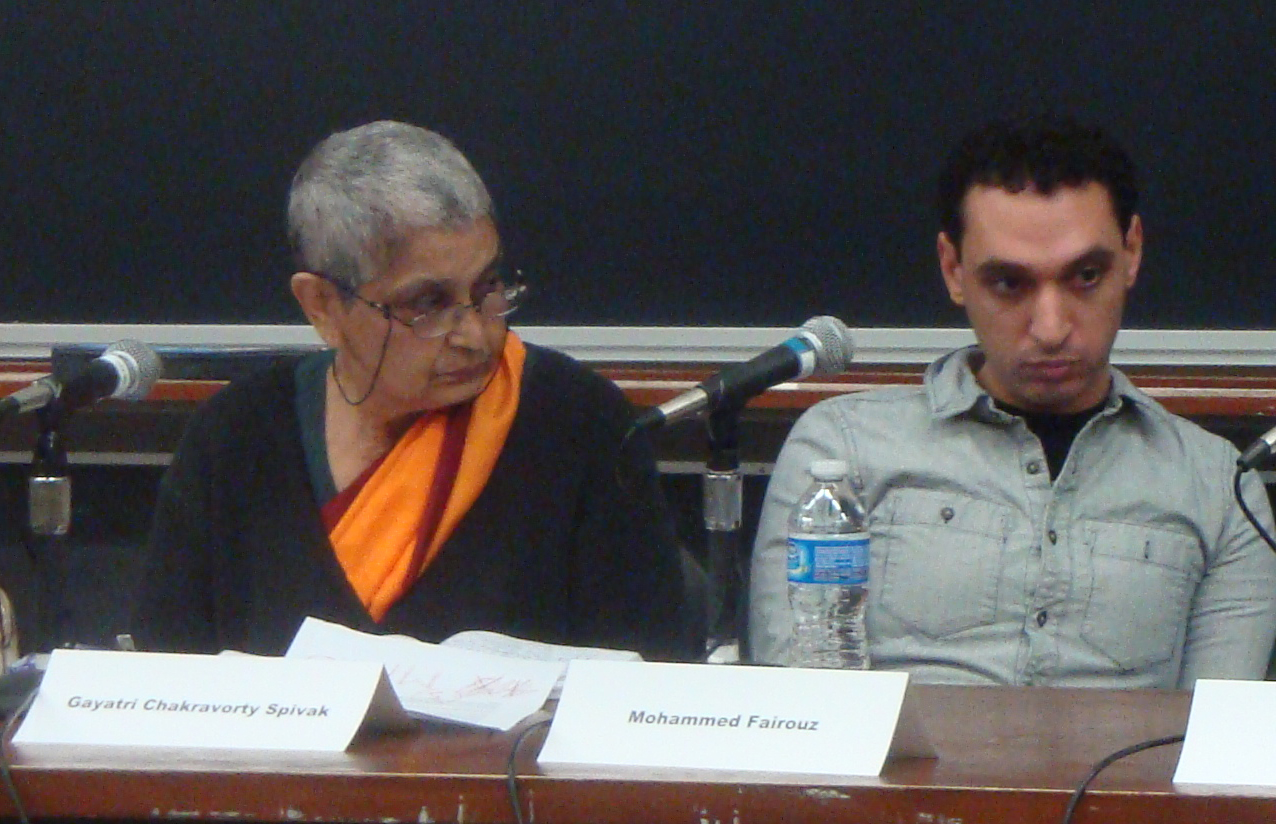
Mohammed Fairouz: "We Don't Live in a Post-Colonial World"

Mohammed Fairouz (right) and Gayatri Chakravorty Spivak
Katrina Weber Ashour and I recently attended a premiere of Mohammed Fairouz's Symphony #3 and a panel discussion, both at Columbia University.  The issues that came up at the panel, titled "Music, Literature, and Comparative Compositions: The Task of Translation" were heady and challenging.  What right does an artist have to put the prayers of other traditions on stage?  What loyalties does an an artist have to his or her own traditions?  Questions that can't, ultimately, be answered but lead to provocative conversation.  Panelists included Sinan Antoon, moderator Gayatra Chakravorty Spivak Michael P. Steinberg, and Jacqueline Rose.  Katrina and I wrote a piece for M. Lynx Qualey's Arabic Literature in Translation.