Showing posts with label Politics. Show all posts

Tuesday, March 11, 2014

On Randa Jarrar's "Why I Can't Stand White Belly Dancers"

There were a lot of hackles raised within the dance community last week when Randa Jarrar, a Palestinian-American writer whose work I'm familiar with, posted her article "Why I Can't Stand White Belly Dancers."  http://www.salon.com/2014/03/04/why_i_cant_stand_white_belly_dancers/ While the sensationalist title (even if true) might have put some off, there were important points raised in the article.

Belly dance is appropriation.  To deny that is a little scary. The art form (and I do consider it that) is taking music, making up names and labels, and claiming space, specialized knowledge, and profit.  All of these are obvious forms of "Orientalism." Additionally, the Western media has historically portrayed Arab men and Arab women in ways that have been demeaning and continues to do so.  Non-Arab belly dance contributes to this image even when claiming to "educate" and "create community."

How people (dancers, musicians, dance students) choose to absorb this reality is an individual choice, but to become only outraged misses an important chance for "white belly dancers" and others to listen to one person's viewpoint from a culture from which we have all gained so much.  (And, we should also all watch Jarrar's included  clip of the fabulous Egyptian dancer Fifi Abdo):

Thursday, May 3, 2012

Review: Alia Malek's "Patriot Acts" in Arab Lit (in English)

My review of Alia Malek's important and ever relevant "Patriot Act: Narratives of Post-9/11 Injustice" is up on M. Lynx Qualey's Arabic Literature in Translation.  The book is part of McSweeney's Voice of Witness Series.

Still trying to find more on the topic, I attended a talk last night at the CUNY Grad Center, "New Modes of Profiling: Muslims, Arabs and South Asians in Post-9/11 United States" with two speakers from Southern California.  For me, as a non-expert, putting names on programs whose effects many of us directly witnessed without understanding (PENTTBOM, Voluntary Interviews, and NSEERS) is more important than those deeply mired in research understand.  Connecting such labels that appear on Power Point slides with the faces of people I know or with stories I personally know of, was more upsetting than I expected.  Of course I've heard of most of these terms--but the haunting and detached voice of an expert who puts it all together as an organized system with a time-frame and statistics and who can explain that, while tactics have changed, the eerie and undefined "goals" of such systems haven't should frighten more people than it does.

Yesterday's speakers, like Malek's book, wisely stressed the importance of putting these cases of surveillance, arrests, informants, and entrapment, in the context of a history of war time society, such as Japanese internment camps, the "Red Scare," and the Civil Rights era.  Another speaker also said people have spoken out much more quickly about these issues than those in the internment camps in the 1940s. But this context, should be used carefully to promote the importance of continuing to speak out to end such cycles of violence.

 Last night, when I asked about places to get more information on this topic, I was somewhat dismissed  (not by the speakers)--and told there's information everywhere.  If this is true, when I talk to smart, educated people about the project I'm working on, why have so few ever even heard of the "Special Registration" or NSEERS?  Though these cases drop into the news at times (such as the recent allegations of the NYPD's activities in New Jersey and Connecticut ) in-depth, reliable information is hard to gather, which is why books like Malek's books geared to readers who aren't experts are so important.

Leaving now to hear Nobel prize winner Herta Muller speak about her upbringing in Romania and "the school of silence."  Part of PEN World Voices this weekend:  "Herta Muller: On Silence."  Muller's "The Appointment" is one of my favorite novels.  I've looked forward to hearing her this afternoon and tomorrow for months.

Sunday, February 26, 2012

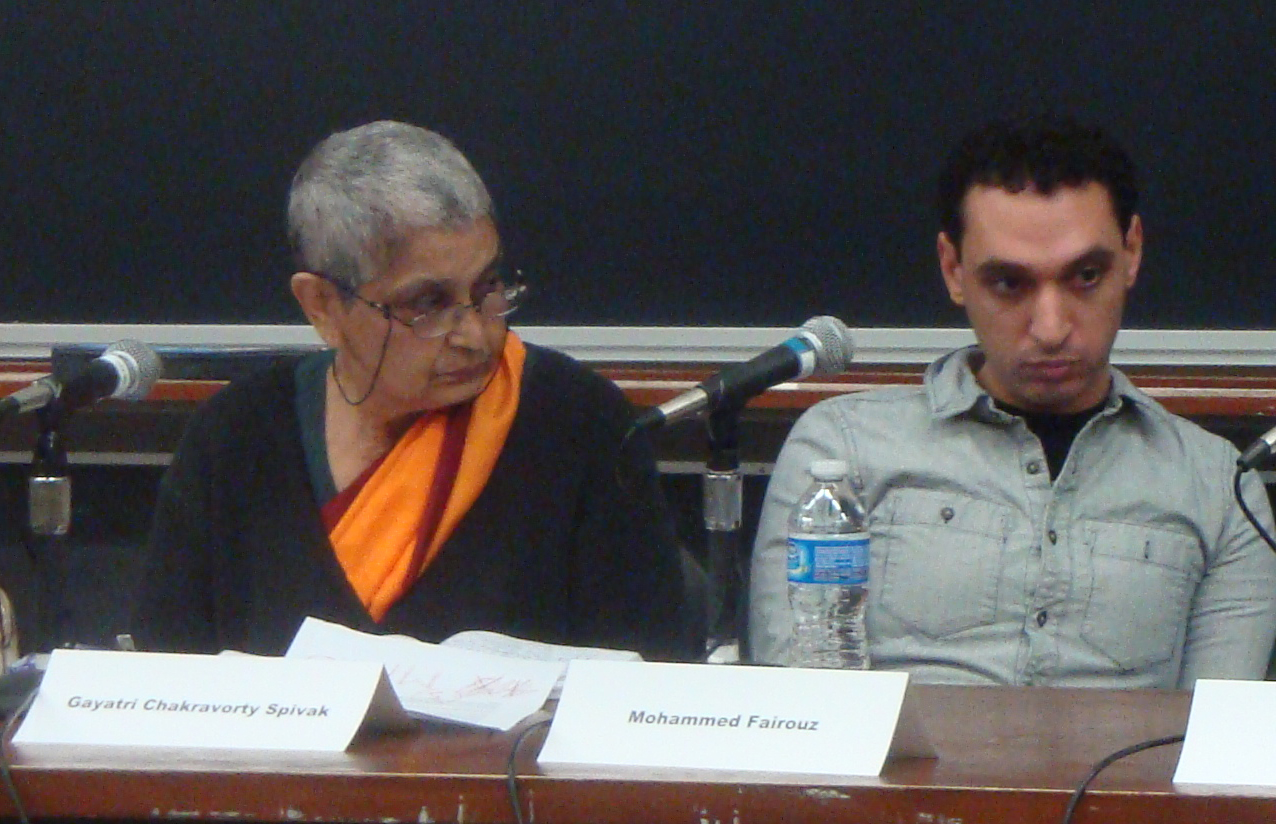
Mohammed Fairouz: "We Don't Live in a Post-Colonial World"

Mohammed Fairouz (right) and Gayatri Chakravorty Spivak
Katrina Weber Ashour and I recently attended a premiere of Mohammed Fairouz's Symphony #3 and a panel discussion, both at Columbia University.  The issues that came up at the panel, titled "Music, Literature, and Comparative Compositions: The Task of Translation" were heady and challenging.  What right does an artist have to put the prayers of other traditions on stage?  What loyalties does an an artist have to his or her own traditions?  Questions that can't, ultimately, be answered but lead to provocative conversation.  Panelists included Sinan Antoon, moderator Gayatra Chakravorty Spivak Michael P. Steinberg, and Jacqueline Rose.  Katrina and I wrote a piece for M. Lynx Qualey's Arabic Literature in Translation.  

Thursday, October 20, 2011

The Rosetta Stone on "Entitled Opinions"


I love the podcasts on Stanford University's  "Entitled Opinions" and get hours of mileage on the elliptical fitness machine thanks to ever smart and intriguing host Robert Harrison and his astounding cadre of guests (look up Blair Huxby on Aristotle's "Poetics," Rush Rehm on Greek tragedy, a two-part session on Beethoven, Epicureanism, or "Romanticism and Organic Form").  The October 12, 2011 episode featured Patrick Hunt on the Rosetta Stone. Politics, ownership, power, Empire, lust, classic Orientalish.   Listen to all podcasts for free at: http://www.stanford.edu/dept/fren-ital/opinions/

Thursday, April 28, 2011

Democracy Now: Rula Jebreal and Issandr El Amrani

Pen America's World Voices Festival hosted a panel last night that featured both journalists featured on Amy Goodman's Democracy Now that appeared earlier the same day. Some of the issues discussed are similar. This clip focuses on Israel, Palestine, and tenuous relations between Fatah and Hamas: